
Beware the Long-Term Costs of Borrowing Language and Cheap Expression from AI
Box Cutter Co. Free Issue No. 88


Have you ever had half-formed, muddled thoughts fluttering around in your mind…
… and then sat down, started writing them out, and arrived at some clarity?
This is one of the fantastic powers of writing.
Writing helps us discover what we know, what we’re thinking, what we’re pretending to know, and what we may need to learn (or unlearn).
Thinking, language, and learning are woven together.
We use words to give shape to foggier things: a feeling, suspicion, intuition, a question, memory, a pattern.
Language is a magical process taking shapeless thinking and thoughts and transmuting them into words and sentences — with shape. Writing things out (or talking them out) is a critical process for discovering, uncovering and processing our thoughts.
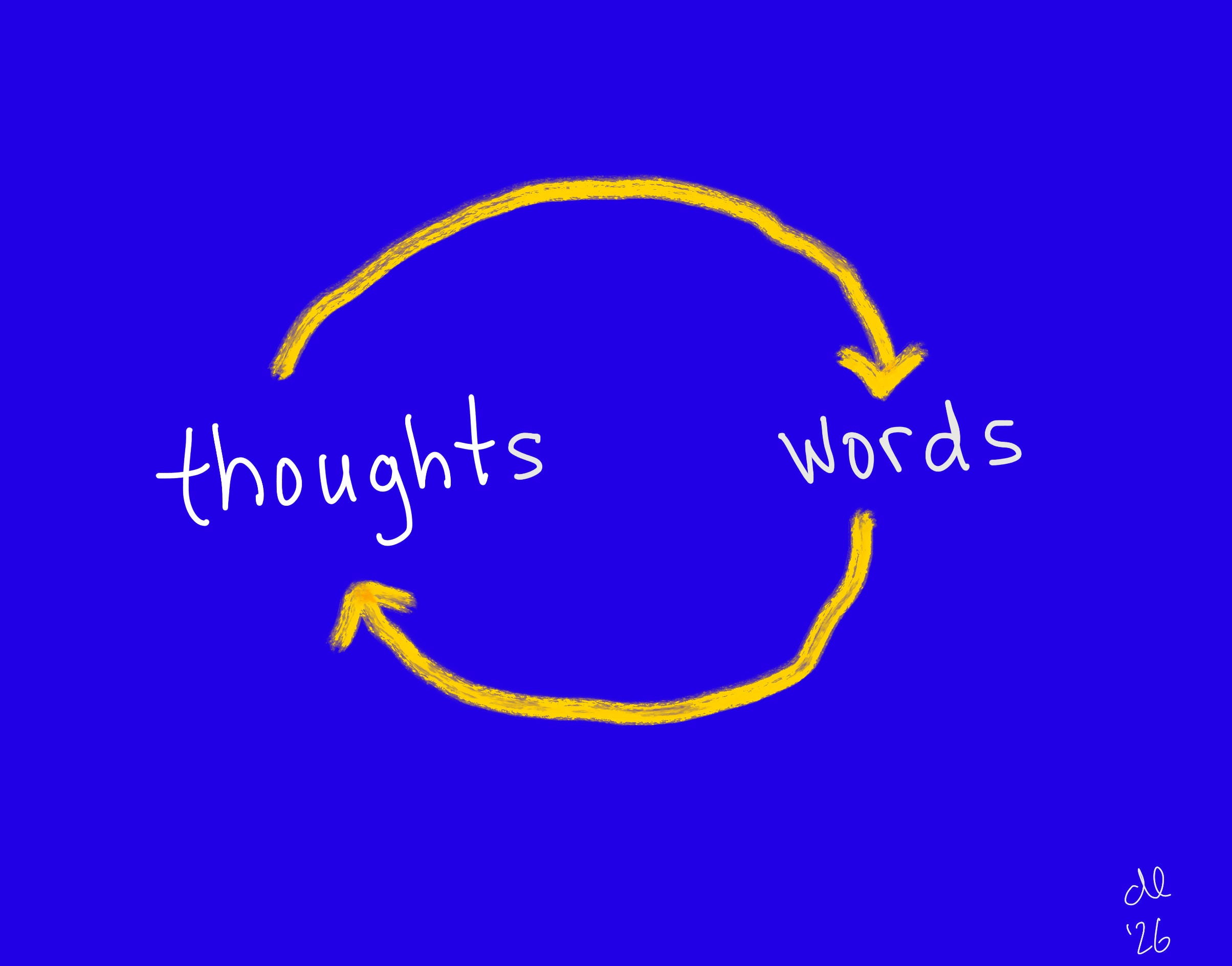
We can think fast, but writing slows things down.
What fascinates me is how I write and think at the same time. Yet, the thinking is quieter, as the writing dominates. Of course, this varies depending on the type of writing I’m doing.
Thus, I vary the kinds of writing I engage in. From free writing (pen and paper) in a Learning Journal — keeping my hand moving. To the day-to-day writing I do as a consultant, faculty member, and writer.
In writing, we are constantly dancing in an in-between space. In between what we know, don’t know, what we suspect or assume, what we might be pretending to know, what we’d like to learn, or maybe ignore, and so on.
But, in recent years, something is changing this — Quickly!
The Flood of Cheap Expression
With AI tools and platforms, almost anyone can “write” something and even sound somewhat competent. But there is a difference between writing your way toward clarity and prompting a prediction machine to produce fluent language.
I am not anti-AI, nor pro-AI. I use it daily.
I have paid for ChatGPT for years and use AI across research, strategy, teaching, editing, planning, analysis, and more. In some areas of my work, it has been genuinely transformative. However, writing, or more precisely, “content production”, is where I am much more cautious and skeptical.
I was an early adopter and still a daily AI user. AI-generated writing is easy to spot. Social media is full of it. Newsletters, too. Websites, bios, course pages, comments, discussion posts, and “thought leadership” pieces are now generic-sounding, same-same.
I estimate that about 70%+ of assignments submitted to the university-level Communications course I teach online are now cut-and-paste AI or deeply influenced by it.
It’s a Sea of Sameness.
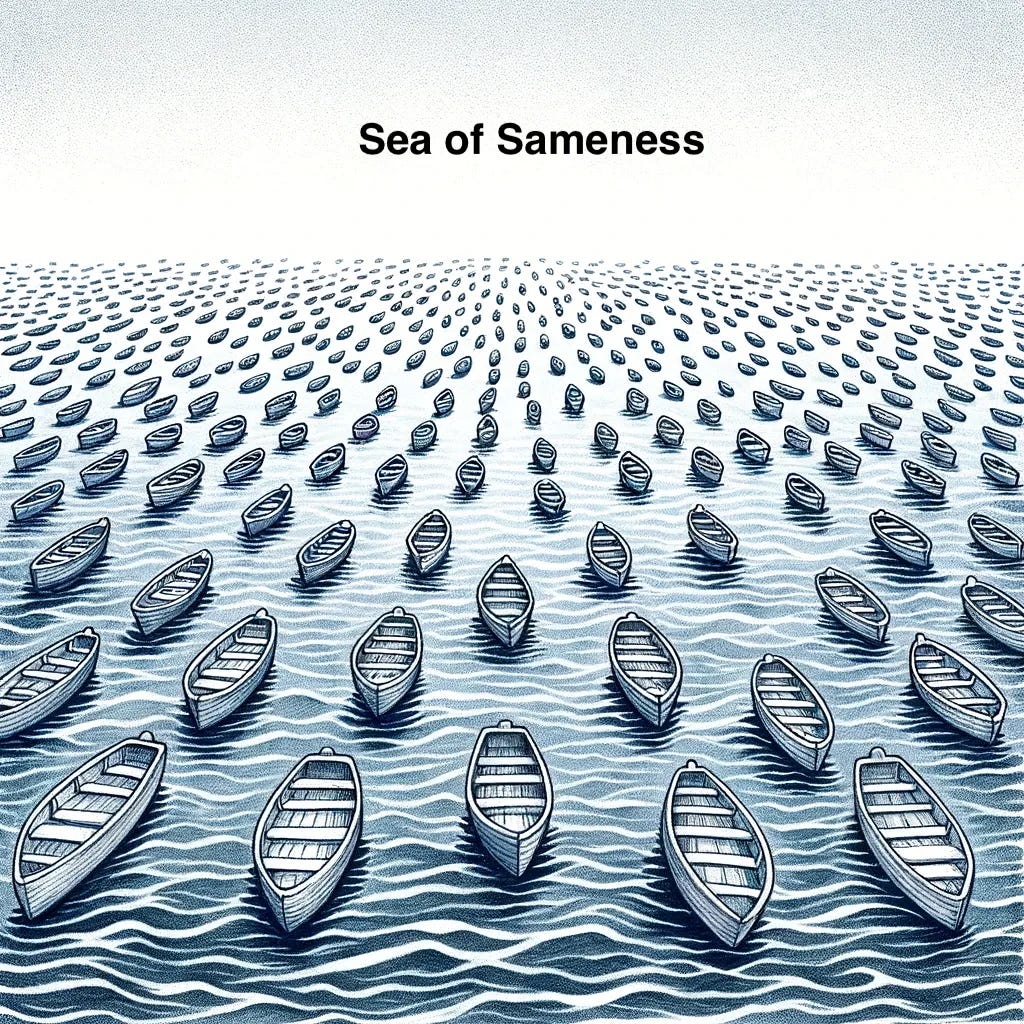
AI Fatigue
I spend a lot of time on LinkedIn: on my profile, for Box Cutter Co., for D. Loewen Strategy Co., for Humanity Academy, and for a nonprofit client whose page I helped grow from zero to nearly 4,500 followers in just over two years.
I am on the feed at least 5x per week, often more. LinkedIn has been beneficial to my business of one.
And, over the past year, I noticed things shifting. My feed is clogged with AI-generated posts, promoted content, and formulaic bumpf. I rarely scroll beyond the first few posts without much personal interest.
This has become the case across most platforms… Substack, Medium, and so on. When everyone can produce some level of fluent expression… expression carries less weight.
It’s simply predictive word combos… and predictable to read.
So, I choose not to read most of it, and I’m seeing similar sentiments from many — especially those who have been at the game for a bit. For me, it’s now over 4 years. Lately, I’ve been thinking more deeply about this, more below.
Power and Prediction
This past week, I grabbed this book off our bookshelf Power and Prediction: The Disruptive Economics of Artificial Intelligence.
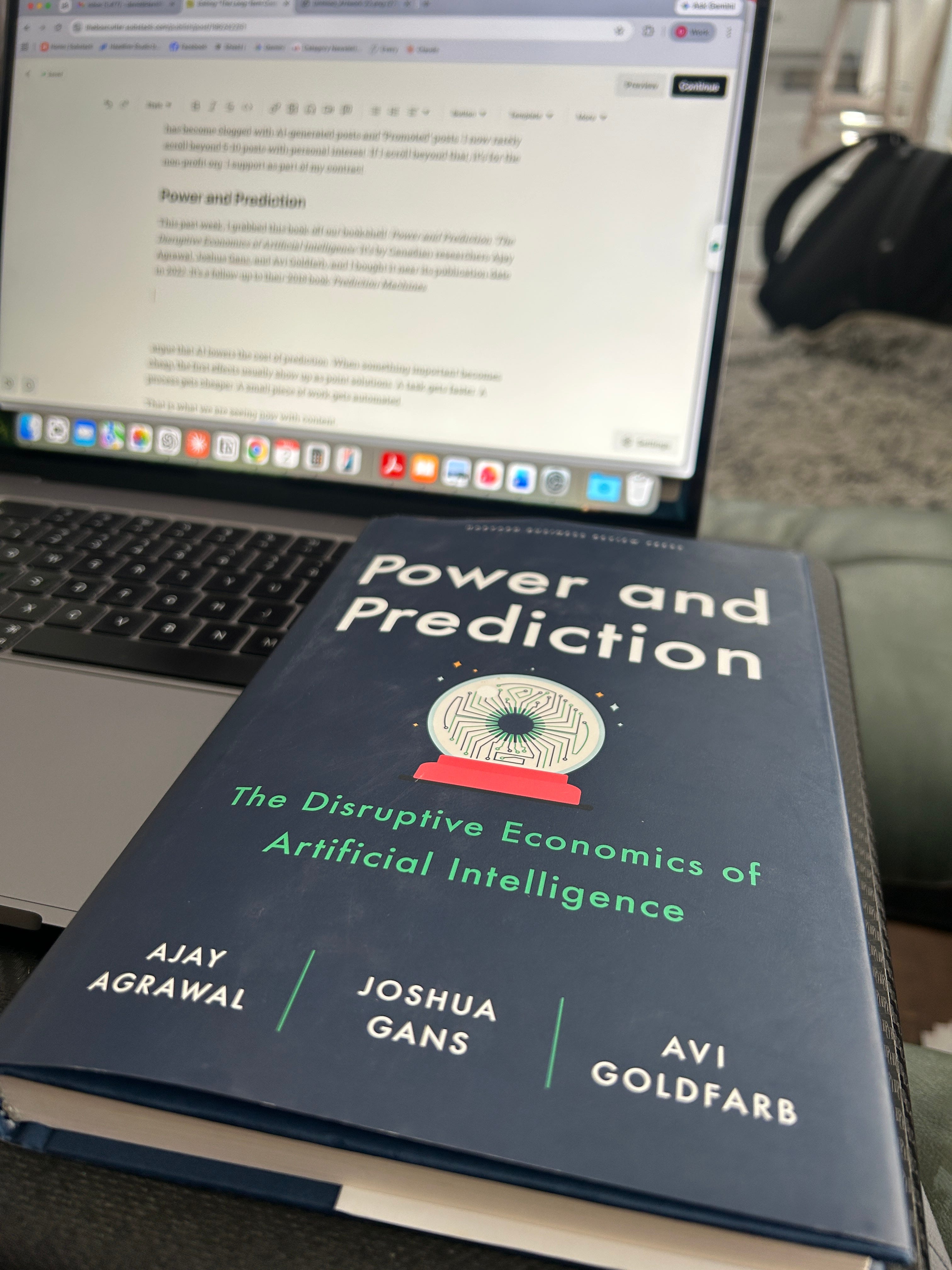
It’s by Canadian researchers Ajay Agrawal, Joshua Gans, and Avi Goldfarb, and I bought it near its publication date in 2022. It’s a follow-up to their 2018 book Prediction Machines.
One of their core messages is inherent in the title of both books — that advances in AI technology are improvements in prediction. AI does not make decisions; it simply provides inputs for human decision-making, they suggest.
For example, consider all the headlines about “AI taking jobs.” No, AI does not take jobs — humans still make those decisions.
Early in their book, they share a parable of three types of historical entrepreneurs, and look back to the technological transition from steam engines to electricity:
The Point Solution Entrepreneur
The Application Solution Entrepreneur
The Systems Solution Entrepreneur
The Point Source entrepreneurs focused on electricity as a new source of power, on the same sites using steam (e.g., steam-powered mills and clothing and textile manufacturers). The focus for these entrepreneurs was on providing cheaper energy by switching to a different energy source.
Application Solution entrepreneurs realized there were big opportunities in using electric-driven motors in individual devices, as opposed to the everything-attached to a central steam-driven apparatus in factories of the time.
This meant tools could now be moved around. Rather than bringing the work to the machine… the machine could be taken to the work. But the limitation was that new tools needed to be designed to house the individual electric motor.
A Systems Solution entrepreneur looks beyond the status quo (e.g. cramped factories built around centralized single-point steam power). In a steam-powered plant, work and materials needed to move back and forth to the centre, where steam-driven tools were located. With electricity, all norms changed.
A good systems-thinker looks beyond norms and considers what’s possible if one were to build from scratch, focusing only on the new technology (e.g., electricity). This is where Henry Ford invented the assembly line, resulting in the Model T car. It would not have been possible with steam power.
Let’s take a look at these 3 in AI economies.
Point Solutions in “The Creator Economy”
The proliferation of AI across economies and easy consumer access has resulted in all sorts of Point Solution Entrepreneurs and opportunities. Similar to early ‘point solutions’ in the transition from steam to electricity, these opportunities focus on ‘saving costs’ (often translated to time savings).
In ‘The Creator Economy’, AI tools enable anyone to produce ‘content’ at scale. Plug in a prompt, and out comes a week of posts. And for those that buy into the common Creator Economy mantra, “just be consistent.”
— Presto! magic bullet.
Anyone can post consistently (without asking, “what’s the point of this…?”)
Add to this, platforms like LinkedIn have a little button: “Rewrite with AI.” Presto! … one more point solution. Point solutions generally mean faster, cheaper and sometimes, but not always, better.
Application Solutions in “The Creator Economy”
The Application Solutions are precisely that… the wide range of AI Applications available. Some of these are tools like ChatGPT, Claude, and Perplexity (all tools I use).
Or, for some entrepreneurs, this has included designing AI application tools such as prompts and templates. I think of the bigger creator-types like Nicolas Cole and Dickie Bush who have their “Write with AI “ newsletter here on Substack.
Or, DAN KOE, who’s been working to develop an AI note-taking/creator app (was Kortex, now called Eden).
Some of this is useful. But much of this is attached to the early ‘creator economy’ as the frame:
produce content
grow audience
sell products
repeat
AI makes ‘the machines’ and ‘tools’ faster, more efficient — sort of like the electrical tools that began transforming the steam engine era. However, these still don’t get at the systems transformation.
System Solutions in “The Creator Economy”?
Is there a Henry Ford-like Systems Solution Entrepreneur in The Creator Economy, yet? Maybe, MrBeast? I’m not so sure.
He didn’t simply make better videos. He studied a specific platform’s incentives: retention, thumbnails, titles, pacing, spectacle, reinvestment, and scale. Then he built a billion dollar+ company around those conditions. That is closer to systems-level thinking.
A point-solution creator entrepreneur asks: “How do I make better content?”
An application-solution creator entrepreneur asks: “How do I build a better content workflow?” Or, “How do I build a better [enter thingee here]?”
Jimmy Donaldson (MrBeast) probably asked something closer to: “What kind of media company becomes possible when YouTube is the environment?” But I’m not sure this is a Henry Ford-like transformation.
Thinking more about this… I don’t think we have the answer to the Systems Application Entrepreneur yet. Most AI use in “The Creator Economy” appears to be point- or application-focused: faster posts, better workflows, more content, automated production, etc.
The full systems-level shift resulting from AI may still be ahead (at least in the creative realm).
Which circles me back to where I land in this pondering, bringing me back to creativity and writing.
Writing is a process of forming thoughts into words, into language, into sentences. Writing is a way to discover what we mean — before we ask a machine to make it sound better.
This means writing starts with Self (more on this below)
The Self Expressing Itself in Systems
In my and our Humanity Academy communication teaching and training work, we work from a systems view of interpersonal communication.
At the heart of this, all communication begins with Self — at the centre of the image below (used in a recent full-day training for trades leaders). This is where interpersonal communication begins, as well as intrapersonal communication (our internal communication).
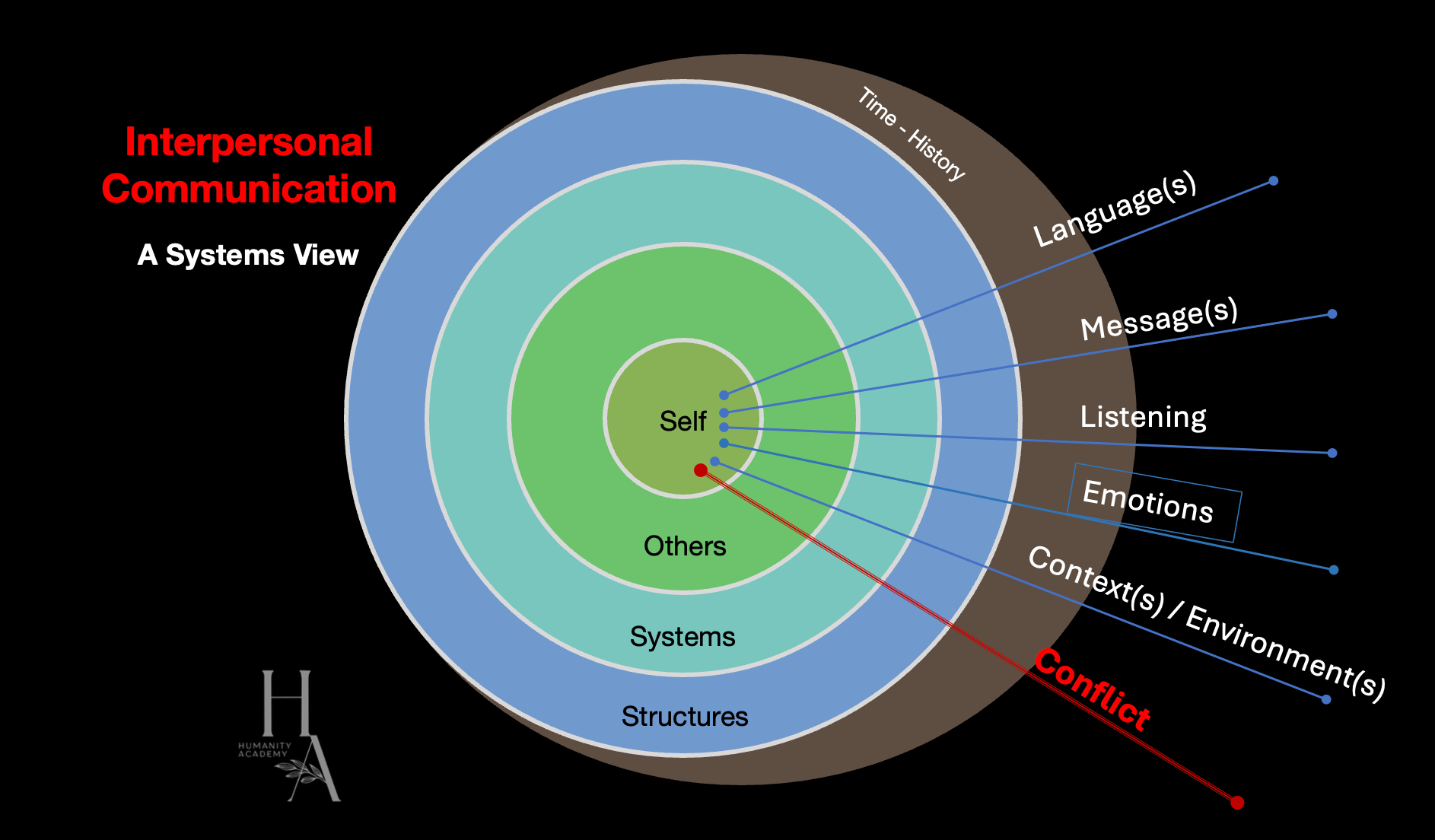
Around each Self are:
Others (family, friends, peers, colleagues, etc.)
Systems (schooling, justice, marriage, etc.)
Structures (citizenship, constitutions, official languages, etc.)
Wrapped around all of these is Time & History. Things change over time. For example, think of changing definitions of marriage. Changing nature of citizenship and official languages. And, so on.
Cutting across all of these are the common components of communication: language (verbal and body), messages (verbal, print, etc.), listening, emotion(s), context(s), environment(s), and conflict.
Every message comes from somewhere. So does every post, newsletter, offer, course, bio, public identity, and creative business.
Who is Expressing their Self?
ChatGPT was released in 2022, the same year I walked away from an employee life and became CEO of my time and energy. I’ve been a near-daily user of ChatGPT since its release. Over those almost 4 years of using AI while also building creative businesses, I’ve consistently returned to what AI cannot do.
Something along the lines of: Who is the Self behind the expressing?
When I rely on AI to write things, I have a hard time seeing myself in the writing. Even trying to ‘train’ AI on my style has produced similar results. Formulaic phrasing. Predictive.
Which… shouldn’t be surprising… that’s what it’s designed to do!
No matter how much information is fed to an AI application, it doesn’t know what shaped me (e.g. family, friends, schooling, languages, etc.). It can’t assume what I assume. Can’t fear what I fear — or even feel or perceive fear.
AI Does Not Perceive, Conceive, or Believe
AI can’t understand what I may be reacting to or against. What I believe, and why. What, where, and why I’ve lived in certain ways.
AI does not have a Self. It doesn’t discern or have tastes.
Relying on it for creating something unique is dangerous, if not pointless. The long-term costs of borrowed language are not bad writing. It’s distance from Self.
You can become fluent in a language that is not yours. You can build a public voice from phrases that travel well but reveal little. And with AI, anyone can produce and publish more while knowing less about what they actually mean.
AI will keep making expression cheaper — but with whose meaning?
The question is whether we will still do the slower work that gives expression weight.
Before asking AI to write, revise, polish, or publish, it may be worth asking:
What am I avoiding?
What am I borrowing?
Where did this idea come from?
What part of this have I actually lived?
What do I believe enough to stand behind?
What would I say without trying to sound impressive?
What does this expression reveal about the Self behind it?
These are not soft, simple questions. Writing some answers out, helps.
These are questions about creativity. Questions about communication. Human questions. And, questions of Self.
This is why I keep returning to Learning Journals, reflective practice, and a systems view of communication. They help me stay in contact with the orginal source of my work.
My Self. (Not a borrowed or cheap expression of it)
The idea of "distance from self" hit a chord with me. AI is a functional writer, and a bit on the boring side of creativity. I wrote an article today and used both a "Field of Dreams" and "Star Trek" reference. It came out of left field (see does AI pun yet?). And AI still doesn't know how much I hate adverbs.
AI can stay on the horizon ... I like my distance.