
Revolutionize Your Digital Writing Skills with a Learning Journal: The Simple Tool with a Massive Impact
7 Ways a Learning Journal will Unlock your Writing and Learning


A Learning Journal might just be the secret weapon you need to supercharge your personal and professional growth — along with your digital writing.
At its core, a Learning Journal is a tool for recording personal thoughts, reflections, and experiences related to learning and development. As a digital writer, your Learning Journal can be a space where you document thoughts and ideas for future writing, document your progress, set goals, and explore new ideas. You can use it to capture successes and challenges, plus reflect on what you’re learning, and experiment with new techniques and styles.
Here is a link to an 8-part series of stories on Learning Journals on Medium:
Unlock the Powerful Benefits of Learning Journals: An 8-Story Series
Enhance your learning with reflective writing and thinking.medium.com
A regular process of tracking your thoughts and reflections in a Learning Journal promotes critical thinking, creativity, and personal growth. They are valuable tools for personal and professional growth.
Whether you’re an aspiring digital writer or a seasoned content marketer or copywriter, a Learning Journal will help you unlock your full potential by providing a place to record your growth, celebrate your accomplishments, and track progress over time.
7 Ways a Learning Journal will Unlock your Writing and Learning
1. Idea Generation
A Learning Journal can be a great place to jot down ideas. By keeping a record of your ideas, you can revisit them later and develop them into articles, posts, or other content. A Learning Journal can also help digital writers identify recurring themes in their ideas, leading to the development of long-term projects and even potential new areas of specialization or focus.
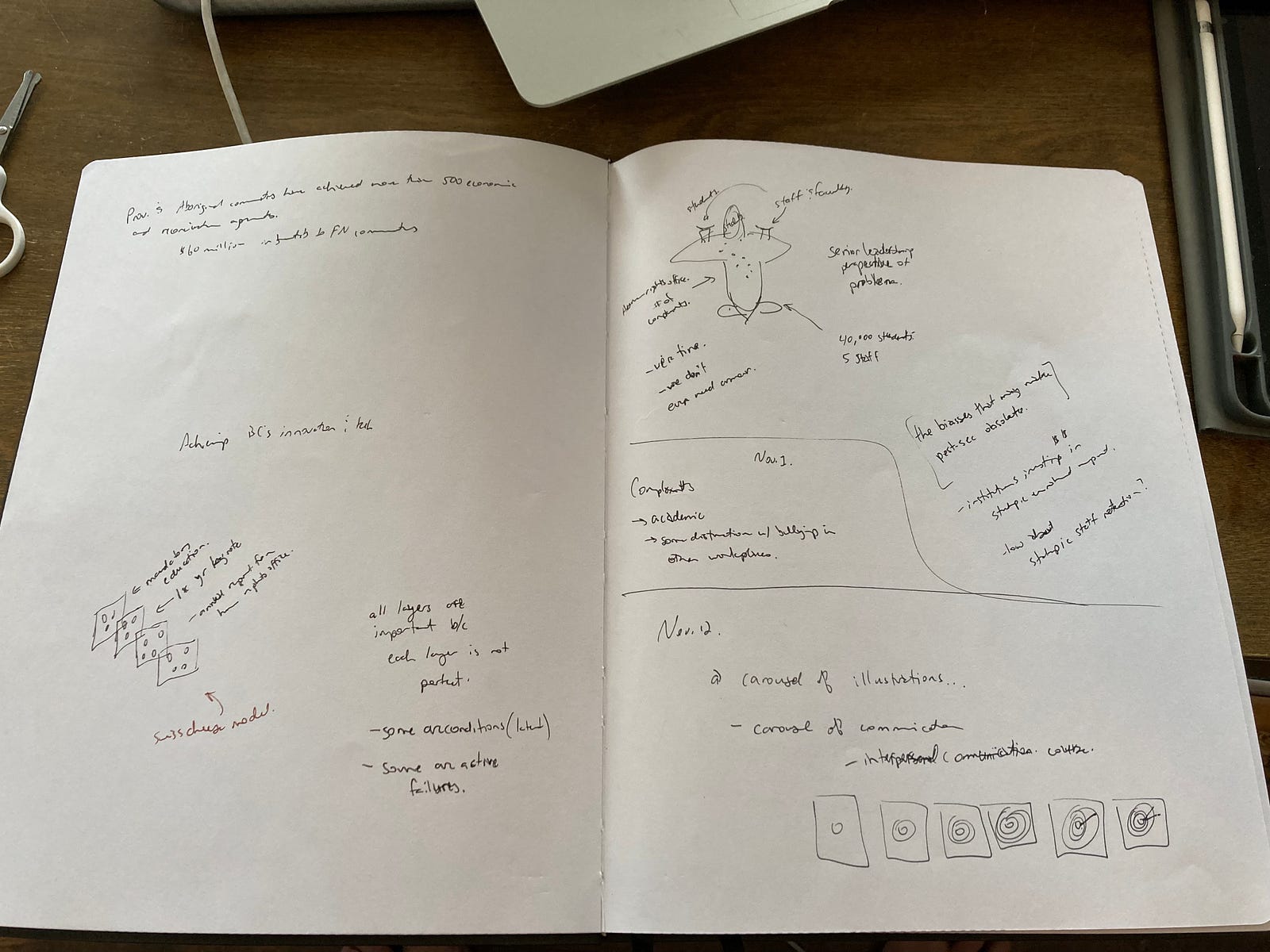
I regularly track ideas and thoughts for pieces. I keep a Learning Journal and pens beside my computers when I’m working and writing.
2. Skill Development
As a digital writer, there is always room for improvement. A Learning Journal can be used to record new skills you want to develop and the progress you are making as you work towards them. Through regular tracking of progress, a Learning Journal can also help writers identify areas where they may need support or resources, leading to more effective skill development and continued growth.
3. Reflection
Writing can be a reflective process, and a Learning Journal can be a space to reflect on your successes and challenges. By reflecting on your experiences, you can identify areas for improvement and celebrate your accomplishments. This process of self-reflection can help digital writers build greater self-awareness, leading to increased confidence, creativity, and overall effectiveness in their work.
4. Learning
Digital writing is a constantly evolving field, and a Learning Journal can be used to record new things you learn. This can include tools, techniques, or even lessons learned from a mistake. By recording what you learn, you can refer back to it later and apply it to future projects.
I regularly refer to Learning Journals I’ve had for several years to fuel writing now.
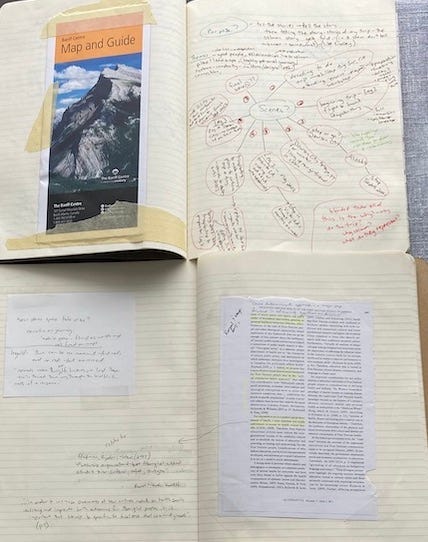
This image above is from a 2015 Learning and Research Journal. I was on my way to a writing workshop at the Banff Centre in Alberta, Canada. I was tracking ideas and taping in artifacts from my trip.
5. Goal Setting
A learning journal can be a great tool for setting goals. By setting goals and tracking your progress, you can stay motivated and focused on your digital writing journey. Through regular review and evaluation of progress toward these goals, a Learning Journal can help writers stay accountable to their aspirations, maintain motivation during periods of challenge or uncertainty, and achieve greater success in their digital writing goals.
I keep a combination of a daily journal to get stuff out of my head, and a Learning Journal where I’m consistently re-visiting goals I’ve set for my digital writing (e.g. income). I adjust as needed.
6. Experimentation
As a digital writer, experimentation is key to staying creative and keeping your content fresh. A Learning Journal can be a place to record your experiments and evaluate their effectiveness. By regularly documenting and evaluating your experimentation process, you can gain insights into what works and what doesn’t, leading to the development of new techniques, styles, and approaches that can take content to new heights.
The digital space can be crowded and is only likely to become more so, experimentation can help you stand out in a crowded online space and build a loyal audience of readers and followers.
7. Collaboration
A Learning Journal can also be used for collaboration, especially in this age of many tools — like Notion, Google Docs, and more. By sharing journals with other digital writers, folks can exchange ideas, get feedback, and explore new resources. Collaborating through a Learning Journal can help digital writers build stronger networks within their field, gain new perspectives on their work, and ultimately create better content that resonates with readers.
In the coming week, I am having a discussion with a colleague that I met online who is based in Germany. I am based in western Canada. We’ve both navigated the academic world and see the power and benefits of Learning Journals.
In Summary
In the growing, fluid, and often competitive world of digital writing, a Learning Journal can be a powerful tool for unlocking personal and professional growth. Using one regularly can provide a space for reflection, experimentation, and collaboration.
A Learning Journal can also help writers stay motivated, focused, and creative in their work. Whether you’re just starting out or looking to take your skills to the next level, a Learning Journal can be a valuable asset on your digital writing journey.
Keep in mind, a Learning Journal is a personal tool, so customize it to your needs. I tend to keep mine using pen and paper, however, digital versions are also an option, too. I just find that as a full-time digital writer, anytime I’m typing on a keyboard, generally means producing something to publish. Whereas writing with pen and paper stimulates another part of my brain.