

A little over 3 years ago, I started Box Cutter Co. Almost 4 years ago, I walked away (cold turkey) from a decade-plus career in the corporate public sector. As I left behind a six-figure salary and good benefits, I had no grand plan. No financial safety net. No clients lined up.
And yet, we had 3 kids all in their teens. We had a mortgage, student loan debts, vehicle payments, and so on. All I knew — we knew — was that it was time for big changes.
On one of our regular walks one afternoon, my wife Lisa Loewen MAIS, RCC said this below:
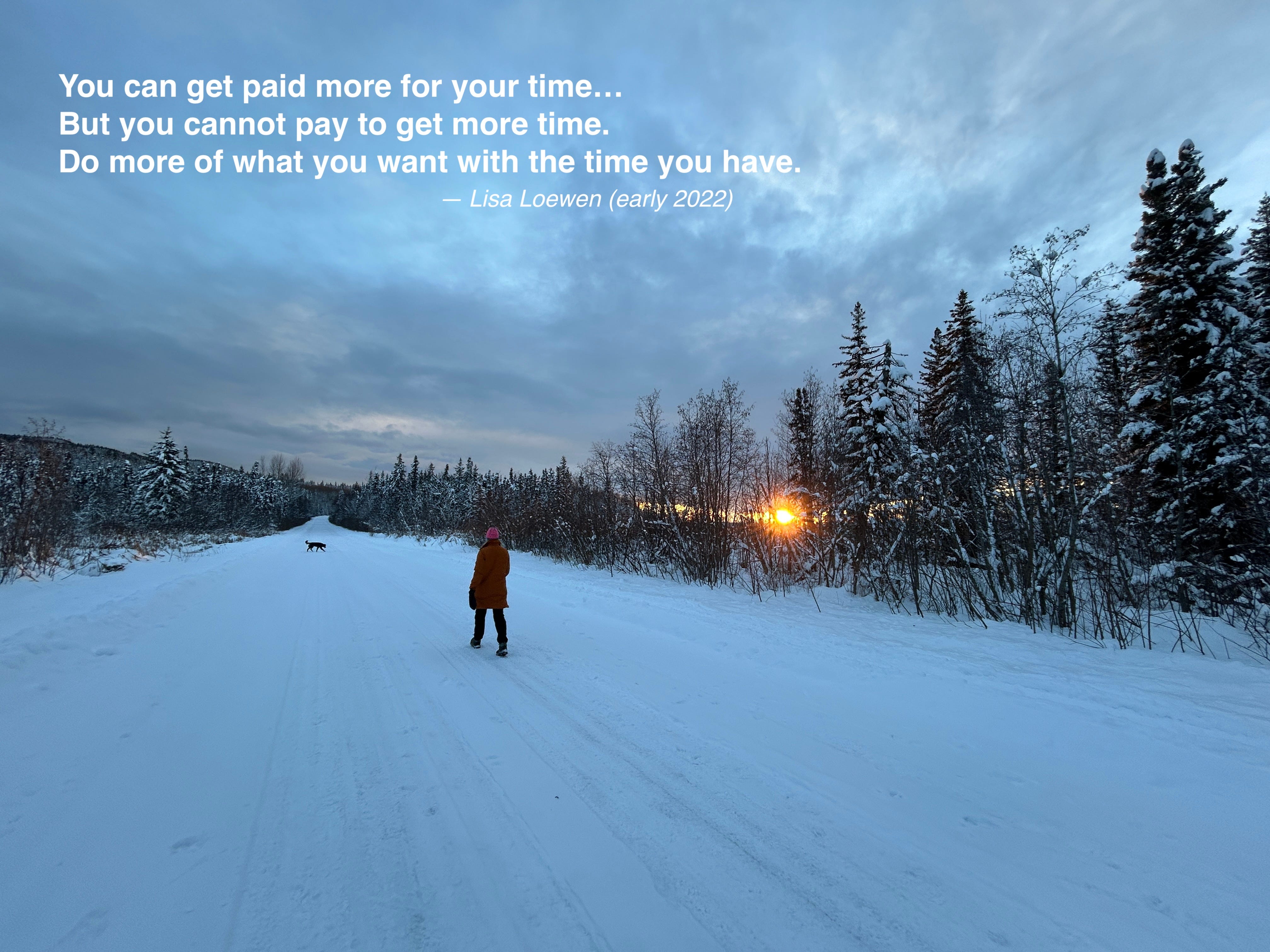
It still sticks in my mind today, years later.
In the meantime, we have built up Soulpreneur enterprises now fuelling revenues (and incomes) beyond what we used to make as employees.
I walked away from corporate employment in April 2022 with a sole focus on becoming CEO of my time and energy. Lisa launched her own counselling practice a year later. We’re both now as ‘busy’ as we need to be, and could be much, much busier if we so chose… but we don’t.
Our decisions and choices are driven by what we value (and prioritize) in our lives, including creativity, connection, solitude, movement, travel, and being available for our kids. Two of whom are now moved out and in the early stages of adulthood. The third is not far off from that.
The creative aspects of our lives (and business enterprises) engage The Creator Economy. We create, write, and publish (ship) weekly. In 2023, we launched a creative social enterprise called Humanity Academy.
Our work focuses on practical, usable, and accessible education and learning, with a focus on the various emotional literacy gaps left unfilled by the education system.
We also publish regularly on LinkedIn, Medium, here on Substack, and various other social media platforms.
But this is not a post about how we entered the less than 4% of over 50 million creators worldwide who make more than $100,000 per year — and are considered “professionals.”
Are You Hoping to Become Part of the 4% Deemed “Professional Creators”?
In 2023, global banking giant Goldman Sachs released a report focused on The Creator Economy. They forecast huge growth in the sector, with total value reaching half a billion dollars by next year (2027).
The report (link above) suggests: “Individual people with their own brands and online audiences have emerged as one of the biggest developments of the digital age.”
However, they also point out: “Only about 4% of global creators are deemed professionals, meaning they pull in more than $100,000 a year.” They forecast this percentage won’t change in the years ahead.
This, despite the flood of posts, Substack issues, newsletters, articles, and courses (most now AI-slop) promising you how to grow your audience, increase your subscribers, go viral, and then selling you $99.99 courses to create your ‘personal brand.’
For those that make it into the ‘professional’ bracket, good on you (if that’s what you want to be doing).
The Number One Creative Solopreneur Problem
This is my 200th published article on Box Cutter Co. In a little over 3 years, I’ve steadily written and published here almost weekly, with occasional slowdowns. On Medium, I’m approaching my 400th published article in 3 years.
In that time, I have seen vastly more people leave ‘The Creator Economy’ than remain active. Of the people I’m connected with, watch, follow, and keep an eye on, I have seen the majority ‘pivot’, switch niches, get frustrated, leave for awhile and come back — and so on.
For many, my subscriber count, given the time and effort invested, may be considered low, a waste of time, “failure.” In fact, this year alone, I’ve only grown by about 30 subscribers. Only 10 since June of 2025. 😱
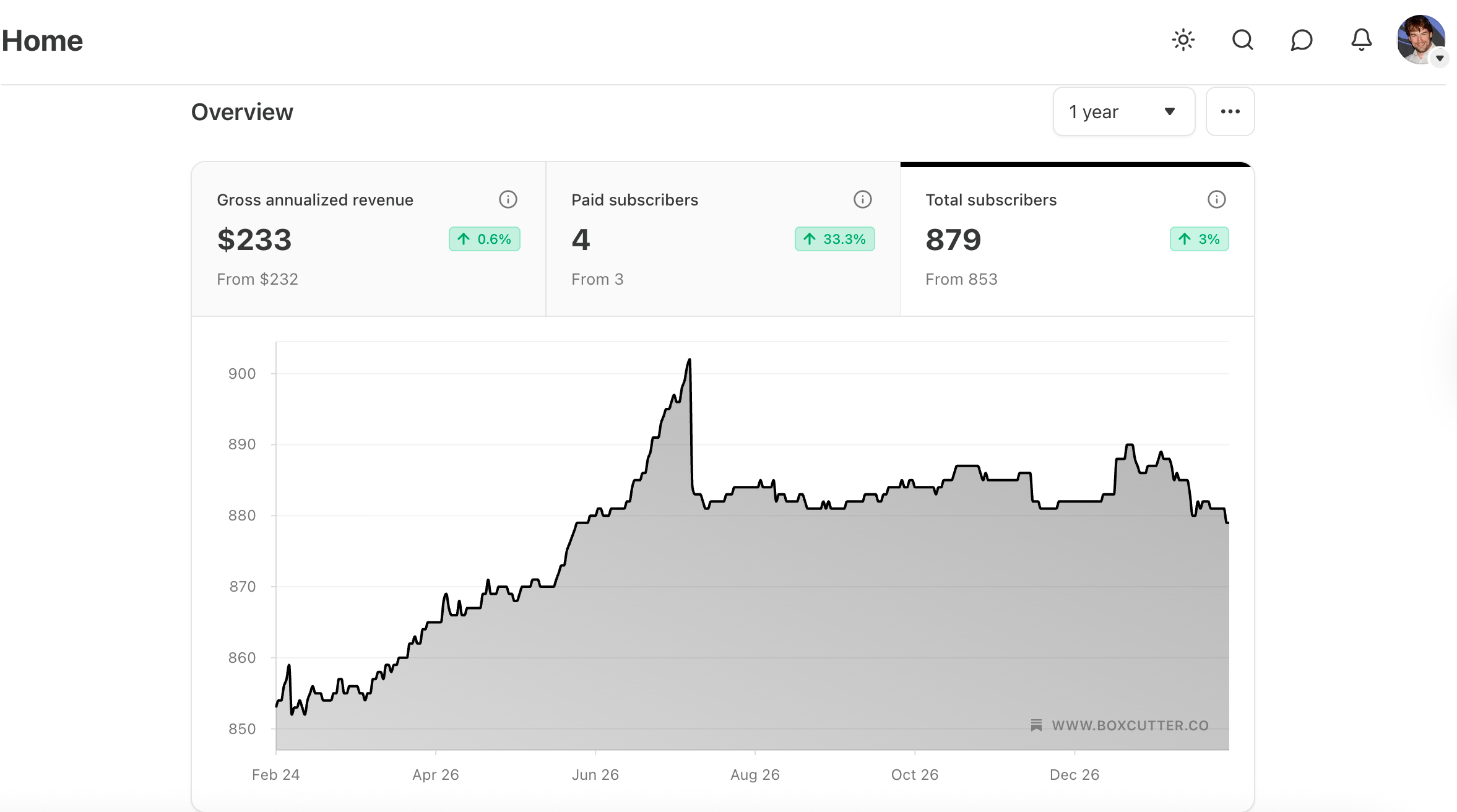
Sure, I published less between June and December 2025; however, in 2024, I sometimes had 30 new subscribers in a month.
Like so many new entrants into “The Creator Economy” — or at least those who want to earn a living from their writing and creative services — these sorts of stats push most out of these endeavours.
Why?
👉 Unrealistic Expectations.
Unclear motivations and unreasonable expectations drive people out of this work — at a rapid rate.
The Creative Solopreneur’s Fix?
Some people don’t like this term: Solopreneur. They prefer the old classic Entrepreneur. But I find there’s a difference, and it’s in that keyword: Solo.
A Solopreneur does all the work, makes all the decisions, carries all the uncertainty, and eats all the admin. (And in our household, also cleans the toilet, makes dinner, and tidies up).
The realities of going solo punish fuzzy thinking, mixed motivations, and lack of clarity on values. It punishes borrowed goals and performative “authenticity.”
We’re fortunate in our household because we are business partners; however, both of our professional practices also operate independently.
And, for us, the cornerstone is simple:
Your business has to reflect who you are at the core.
Core means values. Values show up as decisions and choices. They play out in strategy.
I’ve taught Communications courses for over a decade — including Interpersonal Communication. Much of the information below is similar to materials I teach and facilitate in workshops.
Here’s the frame:
Values = the deep anchors (non-negotiables)
Attitudes = the link between what you believe and what you do
Behaviours = the visible actions swinging hourly, daily, etc.
I’ve often used variations of this image below. And any of you who took my 5-Day Free Email Course: The Solopreneur Thinker, will recognize this.
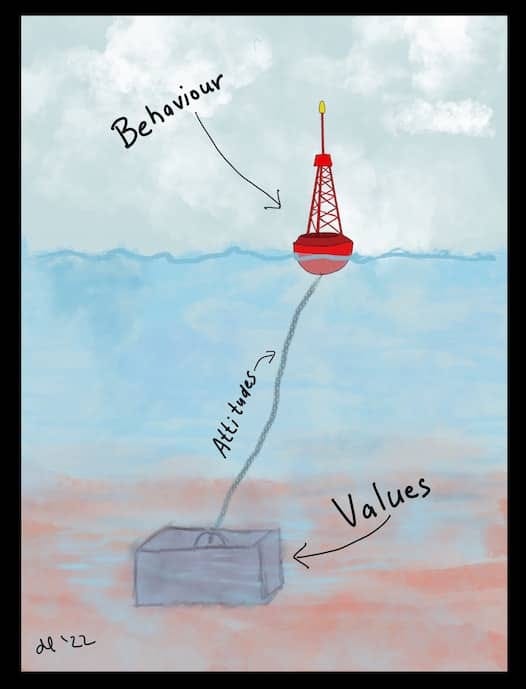
Behaviours change fast. They’re like the buoy floating on the water. It’s affected by all sorts of external influencers: wind, waves, tides, animals, passing boats, etc.
Values change slowly. They’re like the block or anchor holding a buoy in place.
In between these two are our Attitudes. Not as stable and solid as our values. Not as variable and shifting as our behaviours.
The critical job as a Solopreneur (as a business owner) is to ensure your moods (and shifting behaviours) aren’t your business’s operating system.
An example from our household
With Humanity Academy, “Thinking about thinking” sits at the centre of how we make decisions, design courses and offers, and build a life we can live with and within.
Our work is held in place by our individual and collective value systems — which we reflect upon and discuss regularly. If you lose track of your value system in business, you create a significant authenticity (and personal agency) problem.
The Authenticity Problem Online
“Authenticity” online is becoming a costume shop.
I regularly come across posts and articles purporting to be “authentic” yet are clearly AI-slop. We are now in the age of mass content creation. Anyone with an internet connection can simply create a year's worth of mindless content-free content.
Values are what keep this work real and connected to you.
Your values will tell you the truth about what you will do, what you won’t do, what you will tolerate, and what you may need to change. If you move away from your values — e.g. start chasing what you think an audience wants, or chase virality, or chase ‘likes’ and ‘subscribes’ — it will catch up to you.
When the creative work gets hard (and it does), being clear on your values injects the kinds of resilience that can last: the kind you don’t have to fake (or ask AI to outline for you).
Understanding Your 'Whys?'
‘Thinking about thinking‘ fuels us to question our assumptions and biases and to consider new possibilities. (Academics call it metacognition).
I love this line from the Category Pirates 🏴☠️:
“Every legendary business is a dumb idea. Until it isn’t.
Remember: Everything is the way it is because somebody changed the way it was.”
In the context of your creative enterprise (Solopreneur or not), this means not just sticking to traditional solutions when facing challenges, but using your ‘thinking about thinking’ abilities to seek innovative approaches, engage creatively, and often, push through the opinions and perspectives of others around you.
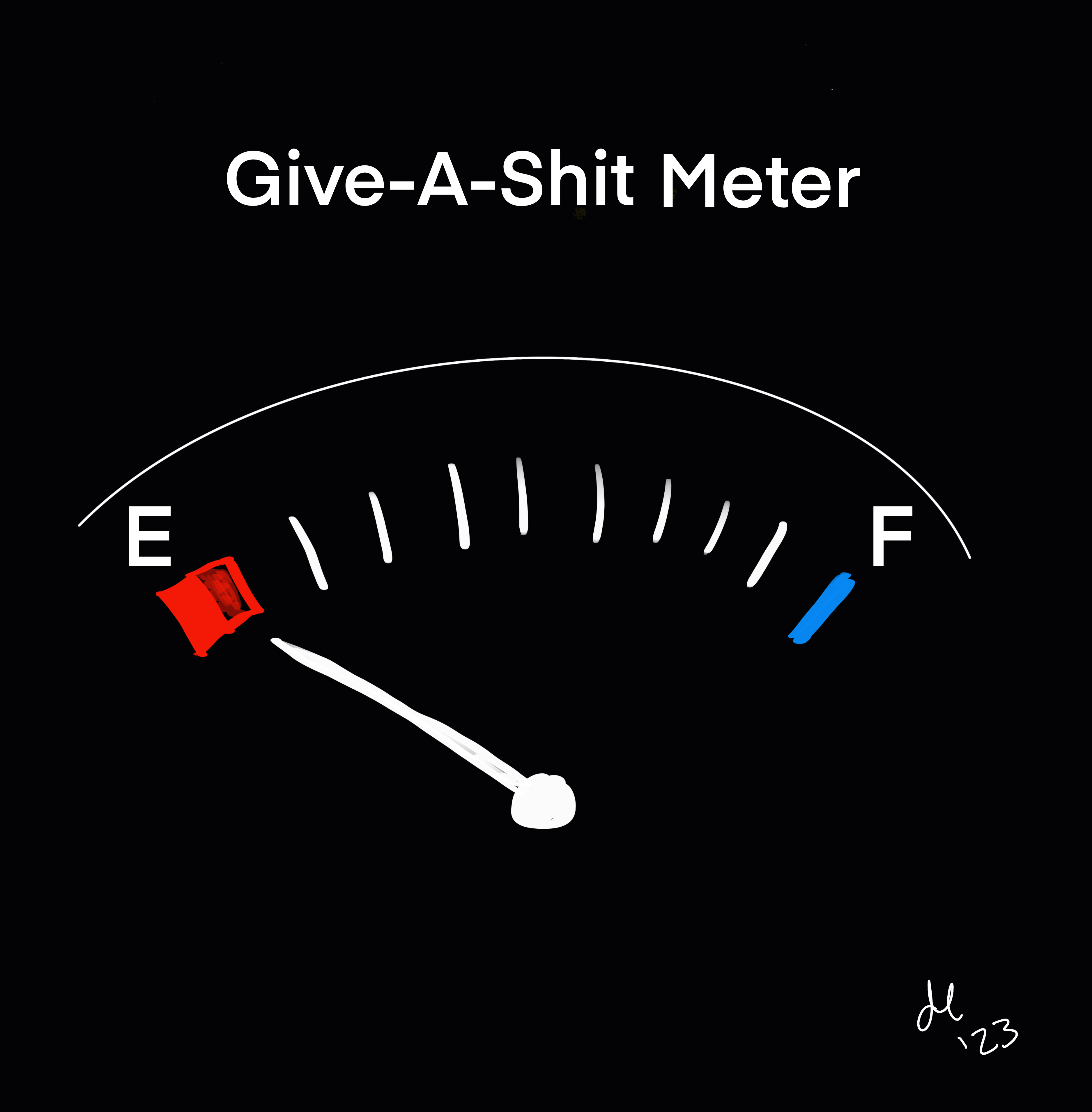
To do this requires having a strong sense of who you are, and often it can mean lowering your “give a shit” meter — so that others’ opinions and perspectives don’t limit your choice to move ahead.
Constructing Your Unique Business Identity
With a little groundwork and cornerstones in place, you can begin construction (or maybe reconstruction).
Here is a reflective exercise, ideally recorded in a Learning Journal to think deeply about your “whys?” and keep your identity at the core of what you’re constructing.
Step 1: Defining Your ‘Why?’
Start by free writing about what defines your ‘why?‘ for embarking on a Solopreneur journey. What’s the deep-seated purpose that motivates you to face the challenges of a Solopreneur?
For me, some of the initial motivation was to Cut the Box - get out of toxic workplaces, org charts, and cubicle offices. This can be important motivation, however, as time goes on it’s important to get at the core values of “why?”
Step 2: Reflecting on Your Values.
List five core values that are most important to you in this journey. Next to each, jot down why this value resonates with you, where you think it comes from, and how it is connected to your ‘why?’
Make sure that these are your values — not ones you’ve inherited from parents, family, friends, schooling, religion, or otherwise.
Step 3: ‘Why?’ in Action.
Reflect on a specific instance where your ‘why?’ helped you overcome a difficult situation in your past, in your work, and/or your Solopreneur journey. How did your ‘why?’ influence your decision-making or actions?
Step 4: Authenticity Check.
With the rise of bullshit online, ‘authenticity‘ becomes crucial.
Reflect on what ‘being authentic‘ and ‘genuine’ mean to you and how it aligns with your ‘why?’ Are there any areas where you could improve the authenticity in your business operations? Are there areas where you feel your ‘authentic Self’ may not be getting properly voiced in your work?
Step 5: Future Alignment.
Lastly, think about your future decisions and actions. How can you ensure they stay aligned with your ‘why?’ And, with your core values. Write down at least three practical steps you will take to ensure this alignment moving forward.
Some of this ‘thinking about thinking’ exercise may seem cheesy or dumb.
However, if you spend some time simply free-writing it, you will find a deeper voice inside you that will come shining through. It’s not the voice of social media posts. It’s not the voice worrying about what others think. It’s a genuine, authentic voice of who you are.
Hear it out. Document it. Revisit it regularly.
Remember, your ‘why?’ is not static, and it will evolve as your business and personal self grow. Make sure to revisit this exercise periodically to keep your ‘whys?’ up to date.
Re-run this quarterly. Run it again any time you feel resentment toward your business or creative enterprises. Our creative work — including writing and publishing regularly — is directly aligned with our values.
Engaging in this type of work is guaranteed to generate deeper and more active self-knowledge. And that relationship is the most important one you will ever have.
Much of this exercise above is drawn from Day 2 of my 5-day Crash Course. Interested to learn more? Check out the course. It’s free. No spam, no catch.