
Why Most Online “Publishing Advice” is Actually Anxiety Management
Box Cutter Co. Issue No. 92

So much online publishing and “Creator Economy” advice plays on the myth that you have a content problem.
You don’t.
But… you might have an attention problem (and probably not the one you expect).
If you’re building a creative business connected to “The Creator Economy,” you’ve probably felt pressure to keep “showing up” (even if you don’t really have anything to say).
And, not because an audience demanded it, but more because silence can feel like falling behind. Uncomfortable. Missing out.
It’s a trap: “being consistent” stops being a creative practice and instead becomes a coping mechanism.
A lot of people post in a similar fashion as to how they relentlessly check their email and social media feeds…
Email and social media do not demand constant checking… but not-checking can create unease and discomfort. Thus, our nervous systems get trained into a coping loop. I’ve felt it.
However, early in 2025, I began to sense that work like Box Cutter Co. was edging away from a creative practice. Maybe, it was becoming an unhealthy addiction — an obsession. One soothed by posting “more content.” Like these cycles below:
Publish → response → relief.
Miss a post → unease → discomfort.
Maybe you also get those uneasy feelings on days you don’t “publish” — the itch to prove you’re still here, still building, still relevant, still somebody.
The irony in satisfying these itches?
They create situations opposite to guidelines for basic communication (e.g., ‘consider your audience.’)
Posting content to satisfy one’s discomfort and unease means it’s no longer about serving an audience or about being useful to others. It morphs into a feeling of falling behind. Falling prey to FOMO.
That loop gets dangerous.
At some point, the constant posting will become dull, meaningless, and empty-feeling. (Might this be why we observe so many creators fizzling out, or “pivoting” their niche, or moving on to the next fad?)
There is no shortage of apparent ‘creator economy’ gurus relentlessly jamming this approach: post, post, post, post, rinse and repeat. Folks like Gary Vaynerchuk, Alex Hormozi, and many more.
If you’re engaged in “The Creator Economy” long enough, you see these proponents of relentless content production in so many circles.
And the Age of AI supports production of ‘content’ at exponentially absurd rates. The internet is flooded with templates, and content producers, and automated content calendars, and ‘Write with AI’ prompts.
The result is a flood of AI slop, slock, and splock.
If you’ve been watching the internet fill up with apparently “helpful” content that’s instantly forgettable, this isn’t a mystery. It’s a predictable outcome of a system promoting absurd frequency, and “be consistent” advice and post relentlessly demands.
But constant production and frequency, for whom? For what?
Slowing Production at Box Cutter Co. in 2025
If anyone were to look at the publishing frequency of Box Cutter Co. in 2025 versus, say, 2024… You might think, gee, it’s petering off.
Fewer published issues. Longer gaps between publishing. Less evidence of “showing up.” (I’ve seen this in notes left by paying subscribers)
The easy story is “oh, he lost interest.” One more of the 99% of people who start a Substack, or a newsletter, or a blog, then disappear.
If you look at “number of posts published” in my stats — yes, there was a slowdown. However, the assumption that I lost interest… That misses the mark.
I didn’t write less in 2025. I redirected it to other initiatives and priorities.
2025 Was a Record Business Year
About 2 weeks ago, I posted on LinkedIn (see below), and this post has gotten a lot of traffic.
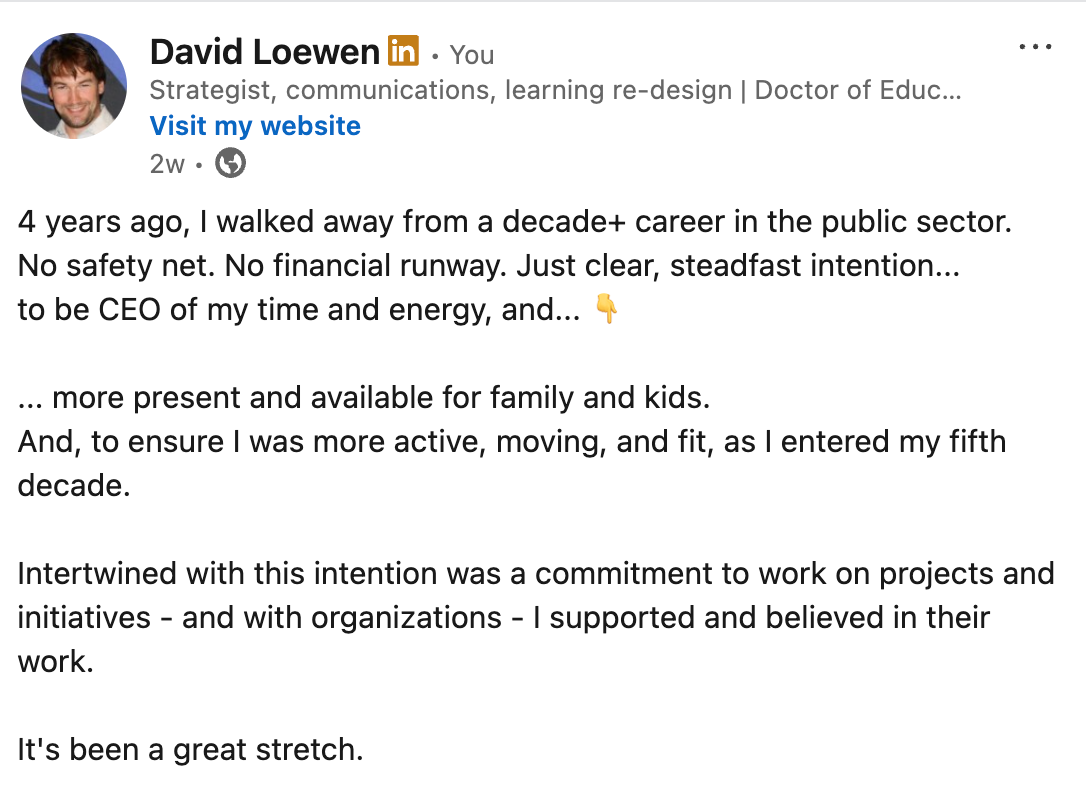
2024 was a good year for business, and 2025 was even better.
In the spring of 2025, my publishing frequency on Substack and Medium slowed significantly. Not because I lost interest, but because I prioritized my energy to other projects and to my self and family.
Business-wise, things picked up on various fronts:
In the spring, I got a contract to write a 4th-year university ‘Communications’ course. It was on policy writing and development, and the ‘Communications’ required to support it.
I continued writing and designing 3 micro-credit courses for a First Nation organization (in partnership with a BC-based university). Those launch this month.
I continued assisting non-profits in development and communications work — including raising hundreds of thousands of dollars for critical projects.
I am still a faculty member teaching six online Communications courses (from first to fourth year)
In 2025, I travelled to the US, New Zealand and all around British Columbia, Canada, including completing at least 3 gravel cycling events.
Much of this work doesn’t create a neat public trail of ‘consistent’ or relentless posts.
Added to this, in the spring of this past year, I noticed something else: relentless publishing wasn’t solving much.
This isn’t to suggest consistent publishing is bad. It’s more… that publishing relentlessly can become an anesthetic for something brewing internally.
When you’re posting constantly, you can avoid sitting in the quiet room, or avoid the quiet solo walks. The places where your mind can go deeper. Think through layers. Unpeel and unpack. Ask a lot of “Why?”
With relentless ‘posting’ and ‘publishing’, you can easily feel like you’re moving. Useful. And feel like you’re proving something (to who knows who?).
You can keep collecting little hits of relief. You can call it discipline and never ask what you’re running from (or towards).
But this is probably inaccurate.
So… for me, I chose “quiet” (on some fronts). And, to ask more challenging questions of myself — especially those connected to:
Why?
And… for whom?
Not the “take a day off” kind, but deeper, quieter practices.
Quiet to sit long enough for internal noise to distill into something that can be named: maybe fear, or resentment, hope, ambition, exhaustion, desire…
And then, “Why?” - connected to the identified emotions.
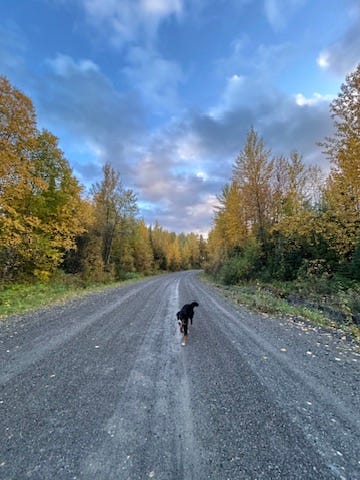
This past year, in the moments between my business commitments and contracts, when previously I would have pounded out a post, published another article… instead, I went for a walk.
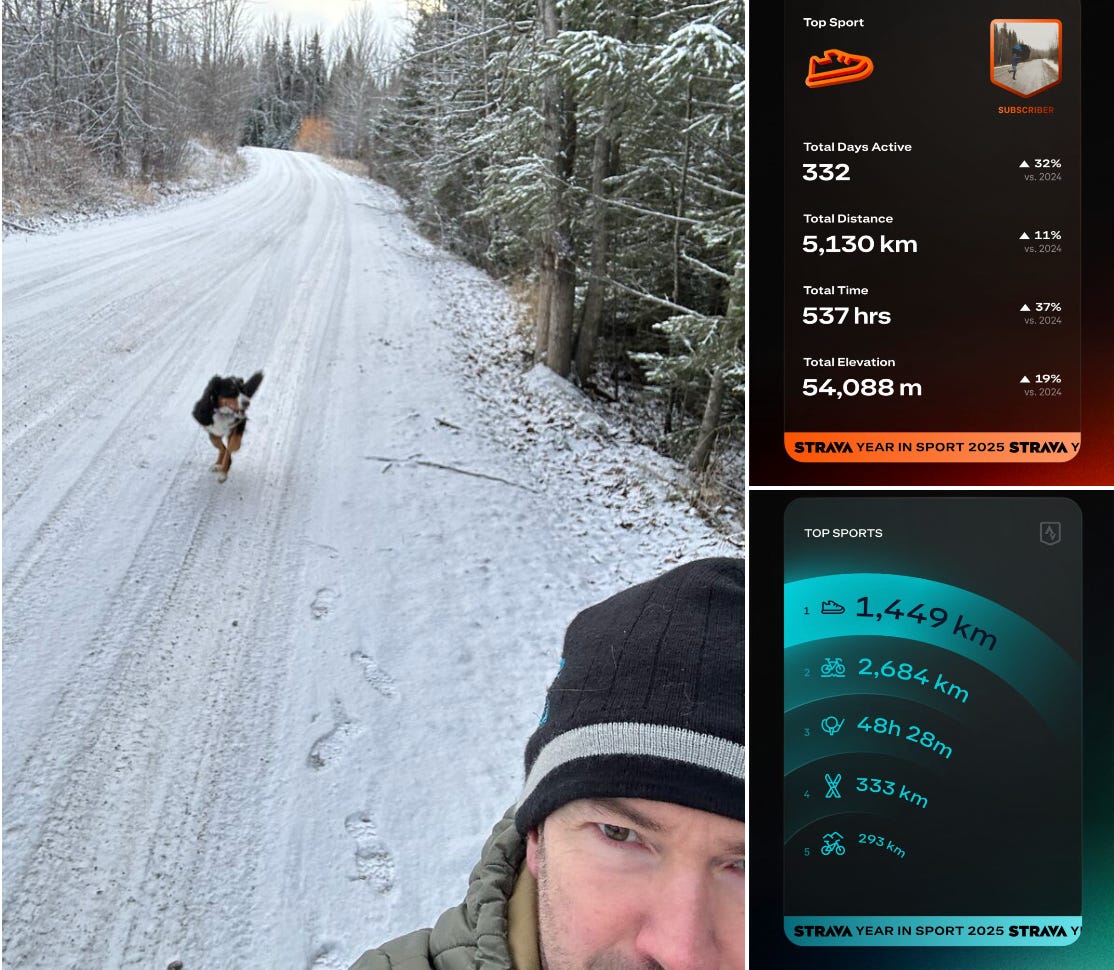
As a result, my fitness app Strava reflected a record year of walking: 1,500 km worth and 332 days with activities, and well over 500 hours of movement 👇
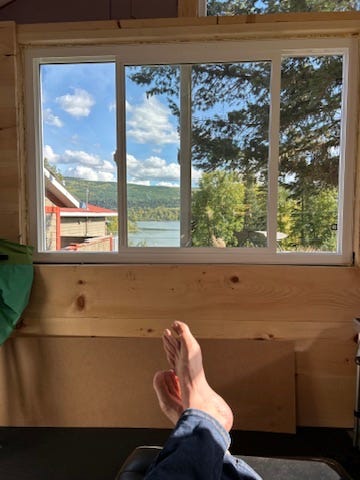
If I wasn’t walking, I was writing in a Learning Journal. Or, sitting quietly and pondering before diving back into work projects 👇
What Slowing Down Provided
When I started Box Cutter Co. late in 2022, I intended it to be a place where I share how I’m going about solving some of my own challenges, what I’m working on, and what I’m learning.
Slowing down on the Box Cutter Co. publishing cadence in 2025 provided a lot of return, for example:
1. Slowing down provided more clarity
Previously, when I published to ‘satisfy a streak’, my standards drifted toward what’s fast, what’s acceptable, what the creator economy hustlers say: “works” and what one “should” do.
When I slowed down the publishing cycle, I was able to explore better questions:
What’s useful and practical?
What’s honest?
What matters?
2. Slowing down made writing more useful and practical
Course-building has a way of exposing fluff. Learners don’t care about your vibe. They care whether the material is usable and clear, whether it helps them do something, and whether it respects their time.
Those tensions force more structure and more empathy (walking in their shoes).
It also forces you to mean what you say. AI-generated slop does not.
3. Slowing down exposed assumptions and motives behind “be consistent”
A lot of consistency advice online is about BS proof-seeking. Proof that you’re disciplined. That you’re still relevant. That you’re not falling behind (FOMO).
When I stepped back and thought about these more deeply, I could see how often my urge to publish was really an urge to soothe my own crap. To prove something to a non-existent individual or force.
4. Slowing down supports stronger creative infrastructure
Course modules, frameworks, lesson sequences, email courses, and durable essays—these don’t require daily performance (e.g., post relentlessly) to keep paying dividends.
For example, I had a nice surprise from Medium the other day. A story I published in January 2025 got picked up somewhere. I got an $80 US payout in Dec. for the story below (a ‘friend link’ so anyone can read it).

Changes Underway in “The Creator Economy” (And a prediction)
I’ve been participating in and watching “The Creator Economy” for almost four years. I’m observing a shift in recent months.
The Internet is flooded with content that is cheap to produce and easy to forget. More takes. More templates. More “useful” posts that sound like every other useful post. More post volume to feed an algorithm or guru-take.
This will continue. Let it. The Age of AI-slop.
But it does create a split and opportunities.
On one side is the content output optimized for pace. Constant publishing, proving, and apparent responsiveness. Lots of surface area, but little depth. Easy to scale.
And!… Easy to replace.
On the other side is work optimized for reality, usefulness, and practicality. Fewer public and published artifacts, more upstream thinking…
This will translate to more ideas and initiatives that can’t be faked by volume and AI slop—because they require judgment (by real people), taste, and, for those publishing, an openness (maybe even willingness) to be temporarily invisible.
The second path seems quieter. But, it’s not. It’s about deeper thinking and reflecting in one’s own brain, before pressing ‘publish’. (Trust me, it can be noisy in there)
That’s the lane I’m navigating.
What this means…
If you’re a subscriber, you probably don’t need more content from me. I’m assuming you appreciate content coming from a mind not trying to escape itself or soothe addictions like FOMO or the constant urge to post.
The kind tested by reality, reflected on for usefulness, and not padded with AI slop.
Don’t get me wrong… I leverage AI every day. In my work building and designing courses, I use AI relentlessly. However, I also constantly fact-check it, challenge it, and use it to look at things from endless angles.
If you’re on LinkedIn, you can see how I’ve recently segmented things out to align with things I’m working on and building, including:
my standard personal LinkedIn page, where I post every week (3-5x)
a new D. Loewen Strategy Co. page reflecting my consulting work and projects
A Box Cutter Co. page, where I share what I’m working on and thinking about, connected to my creative business and this Substack
And, Humanity Academy, the educational startup and social enterprise my wife Lisa and I started about three years ago
Similarly, on Medium, we have publications aligned with each of these, along with a specific writing account called The Learning Journals Initiative.
Stepping back from the relentless posting-and-publishing ‘mode of thought’ and approach provided some space to think.
With that space came more clarity about setting up ‘lanes’ for my many areas of interest, curiosity, and what I do to support a living in the making (not ‘making a living’).
Have you experienced anything like this in your work? Wondering how to do it? Have a question? Reach out.
Happy new year! And looking forward to 2026.
Happy 2026, my friend! Long time no see. This is a great post.
After almost 3 years of consistent posting, I reached the same conclusion about 9 months ago.
I, too, realized I got caught up in the "engagement" game. What I thought was a patient business-building effort was, in fact, a futile race against the shittification of content.
Yes, I got some clients out of this, but my greatest quantifiable gain was 8,000 new followers with whom I have no reason to build relationships, and a handful of coaches and vendors trying to gain visibility by leaving irrelevant comments.
I started noticing a flood of solopreneurs and content creators from Instagram, X, and TikTok on LinkedIn. The platform, which once had a self-regulating "keep it professional" ethos as its greatest competitive advantage, lost its way and became another forum for airing grievances, engaging in political combat, and dispensing life wisdom from 22-year-olds.
The rules of the game have changed drastically. Consistency is no longer a strategy when everyone can bombard the internet with soundbites, images, and videos at zero cost and mental effort.
Hey David, I absolutely love your writing and your insights and perspective on the creator economy, it’s been hugely beneficial to me over the last year, silently reading your stuff, just thought I’d send some appreciation now!